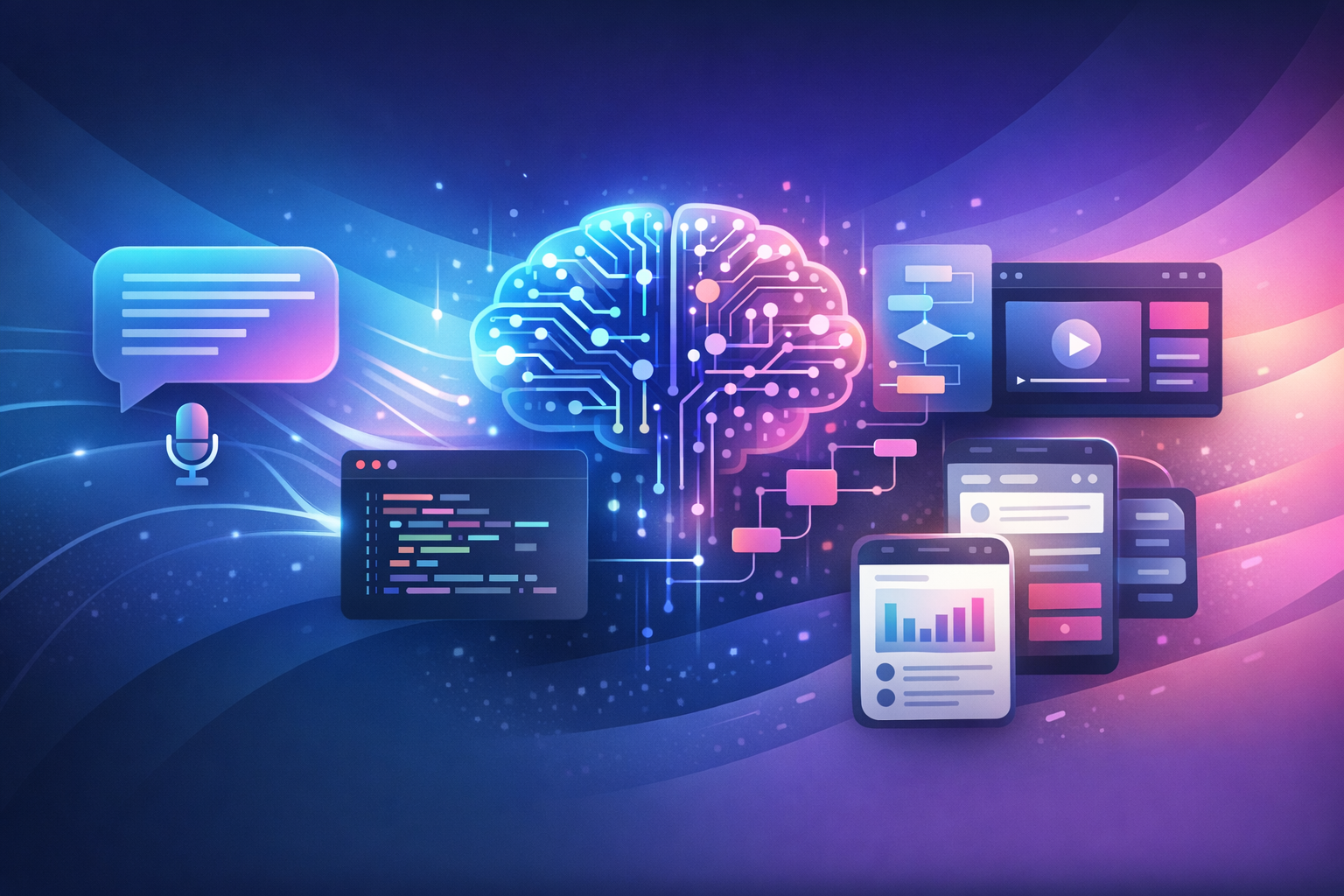
Vibe coding is the process of building software by describing what you want in natural language and letting AI generate the code, UI, and logic. Instead of writing code directly, you iterate through prompts and outputs, guiding the system until the application behaves as expected.
Why this term matters “Vibe coding” is one of the most widely used terms in AI software conversations in 2026. It captures a shift from writing code to directing systems. But it is often misunderstood. Some see it as the future of programming. Others dismiss it as unreliable. The reality sits in between.
Origin of the term The term gained traction around 2025, popularized in developer circles by people like Andrej Karpathy. It described a new way of working where developers would “vibe” with AI systems, guiding them conversationally instead of writing everything manually.
Since then, the meaning has expanded. It now includes non-developers building apps entirely through prompts.
The three flavors of vibe coding in 2026
1. UI-first vibe coding (Lovable-style)
This focuses on generating interfaces quickly. You describe a dashboard or app screen, and the system produces a working UI.
Strength: speed and visual output
Limitation: weak backend and logic
2. IDE-assisted vibe coding (Cursor-style)
Here, developers work inside an editor while AI assists with code generation, debugging, and suggestions.
Strength: strong for developers
Limitation: still requires technical understanding
3. End-to-end vibe coding (Bolt, v0-style)
This attempts to generate full applications including frontend and backend from prompts.
Strength: fastest path to a working app
Limitation: structure and reliability issues
Each flavor solves a different problem, but none fully replace structured development.
When vibe coding works brilliantly
Prototypes You can go from idea to working demo in hours. This is where vibe coding shines the most.
Internal tools For low-risk systems used by small teams, speed matters more than perfect structure.
Demos and experiments Testing ideas, validating concepts, and exploring workflows become significantly faster.
In these cases, the goal is speed, not long-term reliability.
When vibe coding breaks
Production traffic Systems built through prompts often lack the structure needed to handle real users at scale.
Security requirements AI-generated code frequently misses edge cases around authentication, validation, and data access.
Multi-feature scope As the app grows, inconsistencies and conflicts appear between features.
Regulated industries Compliance requirements make unstructured generation risky.
The common pattern is this:
vibe coding works for the first 80 percent
and struggles with the last 20 percent
Why this happens
Vibe coding optimizes for generation, not systems.
It produces working features, but not always coherent architectures.
As complexity increases, the lack of structure becomes visible:
harder to debug
harder to extend
harder to trust
This is why many vibe-coded apps never reach production.
Vibe coding vs AI virtual engineer
Vibe coding is unstructured and conversational.
An AI virtual engineer is structured and lifecycle-driven.
With vibe coding:
you prompt
you iterate
you patch
With systems like Avery.dev:
changes are scoped
tracked
reviewed
deployed
The difference is not just tooling.
It is process.
Vibe coding helps you create.
AI virtual engineers help you ship and maintain.
Is vibe coding real engineering?
It depends on how it is used.
On its own, vibe coding is closer to prototyping than engineering.
With structure and validation, it can become part of a real engineering workflow.
Can a non-developer vibe code?
Yes. That is one of its biggest advantages.
Non-technical users can now build working applications by describing what they want.
However, moving from prototype to production still requires structure.
Is vibe coding here to stay?
Yes, but in a different form than many expect.
It will remain a powerful way to generate software quickly.
But it will increasingly be combined with structured systems that manage what happens after generation.
The bigger shift
Vibe coding is not replacing programming.
It is changing where effort is spent.
Less time writing code
More time defining intent and validating systems
That shift is permanent.