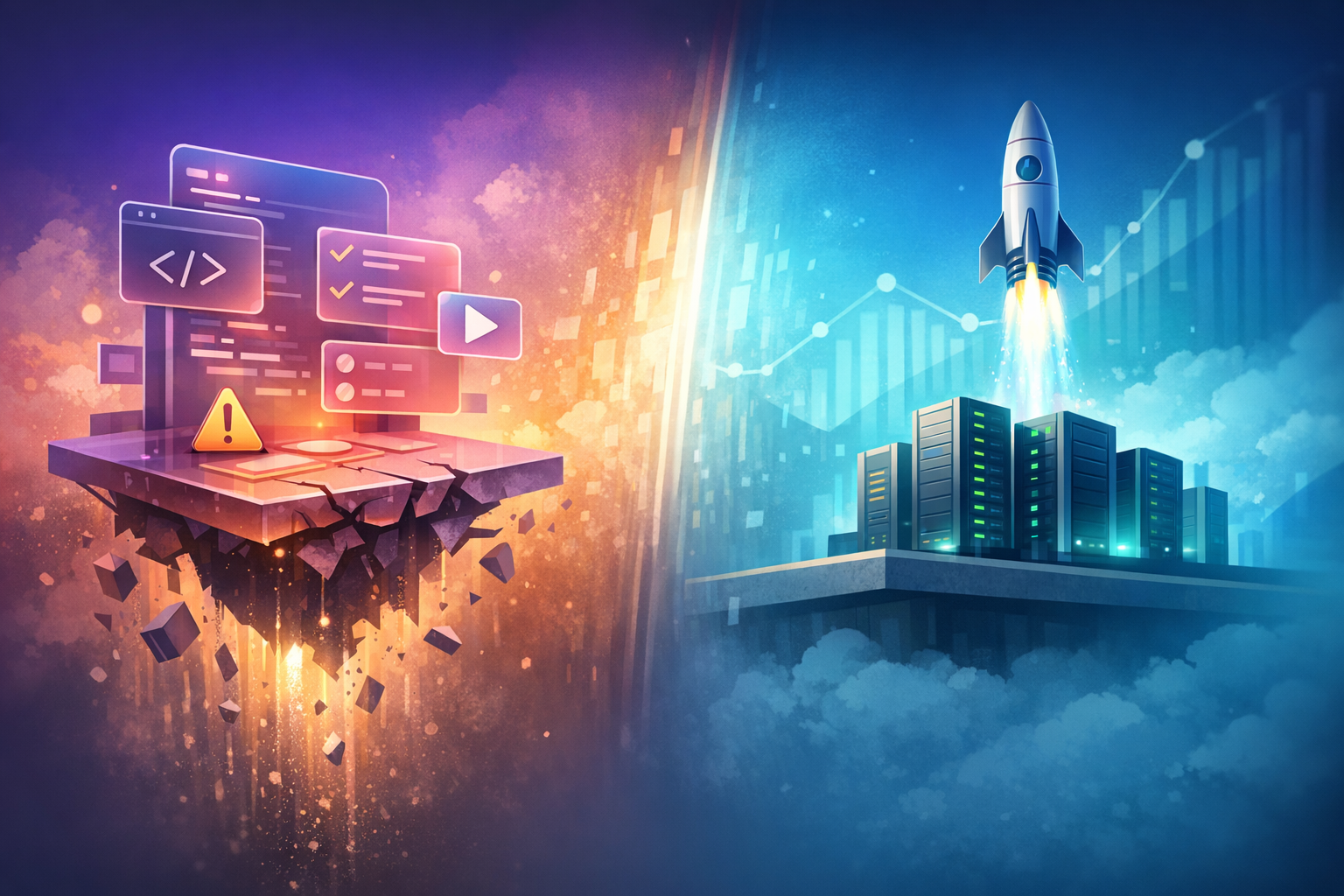
Direct answer (why do vibe-coded apps fail to reach production?) Most vibe-coded apps fail because they optimize for speed, not structure. They generate working features quickly, but accumulate rework debt, security gaps, missing infrastructure, and maintenance complexity. The final 20%, turning code into a reliable system is where most projects break.
The uncomfortable data point Across projects we’ve seen imported from AI coding tools, roughly 80% would not have reached production without significant engineering intervention. Not because the ideas were bad. Not because the tools were weak. But because the systems were incomplete.
What is vibe coding (and why it works at first) Vibe coding is building software through prompts, iteration, and intuition rather than structured engineering. It feels fast, creative, and empowering. You describe what you want, the system generates it, and things work quickly.
That’s why it’s so compelling.
But that same approach breaks under pressure, especially after the first few features.
The four hidden costs of vibe coding
1. Rework debt
Vibe-coded apps are built incrementally without a consistent structure. Each new feature introduces edge cases, inconsistencies, and duplication.
At first, this is invisible.
Then small changes start breaking unrelated parts of the app.
Eventually, you’re not building anymore, you’re fixing.
Rework debt is the cost of rewriting what was generated quickly but not designed properly.
2. Security remediation
Most AI-generated apps are not secure by default.
Common issues include:
exposed API keys
missing authentication checks
weak data access rules
unvalidated inputs
These don’t show up in demos.
They show up in production — often as failures or breaches.
Fixing security after the fact is significantly harder than building it correctly from the start.
3. Infrastructure setup
Vibe coding focuses on generating code, not running systems.
That means missing:
databases configured for scale
deployment pipelines
monitoring and logging
background processing
This is where most projects stall.
The app exists but it can’t run reliably.
4. Ongoing maintenance
Software is not static.
Every app needs updates, fixes, and improvements.
Vibe-coded systems lack structure, which makes maintenance harder over time:
changes take longer
bugs become harder to trace
confidence decreases
Maintenance becomes the dominant cost, not building.
Why chat-as-PM breaks at the second feature
Vibe coding treats chat as the primary interface for building software.
This works for one feature.
Maybe two.
But after that, problems emerge:
no shared context
no structured history
no clear ownership of changes
Each new request is disconnected from the previous system.
The result is drift, the app slowly becomes inconsistent.
This is where most projects start to collapse.
The “last 20%” principle
The first 80% of building an app is easy with AI.
You get UI, logic, and basic functionality quickly.
The last 20% is where the real work is:
making it secure
making it reliable
making it scalable
making it maintainable
And that last 20% often takes more time than the first 80%.
This is why most vibe-coded apps never ship.
They get stuck in the tail.
Why the tail is expensive
Because it requires a different mindset.
You move from:
“Does this work?”
to:
“Can this run reliably for real users over time?”
That shift introduces complexity — and most vibe-coded systems are not designed for it.
When vibe coding is actually fine
Vibe coding is not wrong.
It’s just limited.
It works well for:
prototypes
internal tools with low risk
solo projects and demos
early validation
In these cases, speed matters more than structure.
The problem is using the same approach for production systems.
Where things go wrong
Most builders don’t realize they’ve crossed the line.
What started as a prototype becomes something people rely on.
But the underlying system hasn’t evolved.
So the app:
breaks under load
becomes hard to change
loses reliability
And eventually gets abandoned or rebuilt.
The real cost is not technical
It’s momentum.
When a project stalls at 80%, teams lose time, confidence, and energy.
That cost is far higher than fixing code.
The shift happening in 2026
The industry is moving from:
AI that generates code
to:
systems that manage the full lifecycle
Because the problem is no longer building.
It’s shipping and sustaining.
Platforms like Avery.dev reflect this shift focusing on structured systems rather than unstructured generation.
Final takeaway
Vibe coding feels fast because it skips structure.
But that structure doesn’t disappear, it shows up later as cost.
That’s why most AI-built apps never ship.
Not because they couldn’t be built.
But because they couldn’t be finished.