The AI coding space is exploding. Dozens of tools now let you describe an app in plain English and get working code in seconds. It's impressive. It's fun. And for anything beyond a prototype, it falls apart fast.
We built Avery because we saw a fundamental gap between what AI coding tools deliver today and what it actually takes to build, ship, and maintain production software. This post explains where the current generation falls short and how Avery takes a fundamentally different approach.
The Problem With AI Coding Today
Most AI coding tools fall into two camps, and both have the same blind spot.
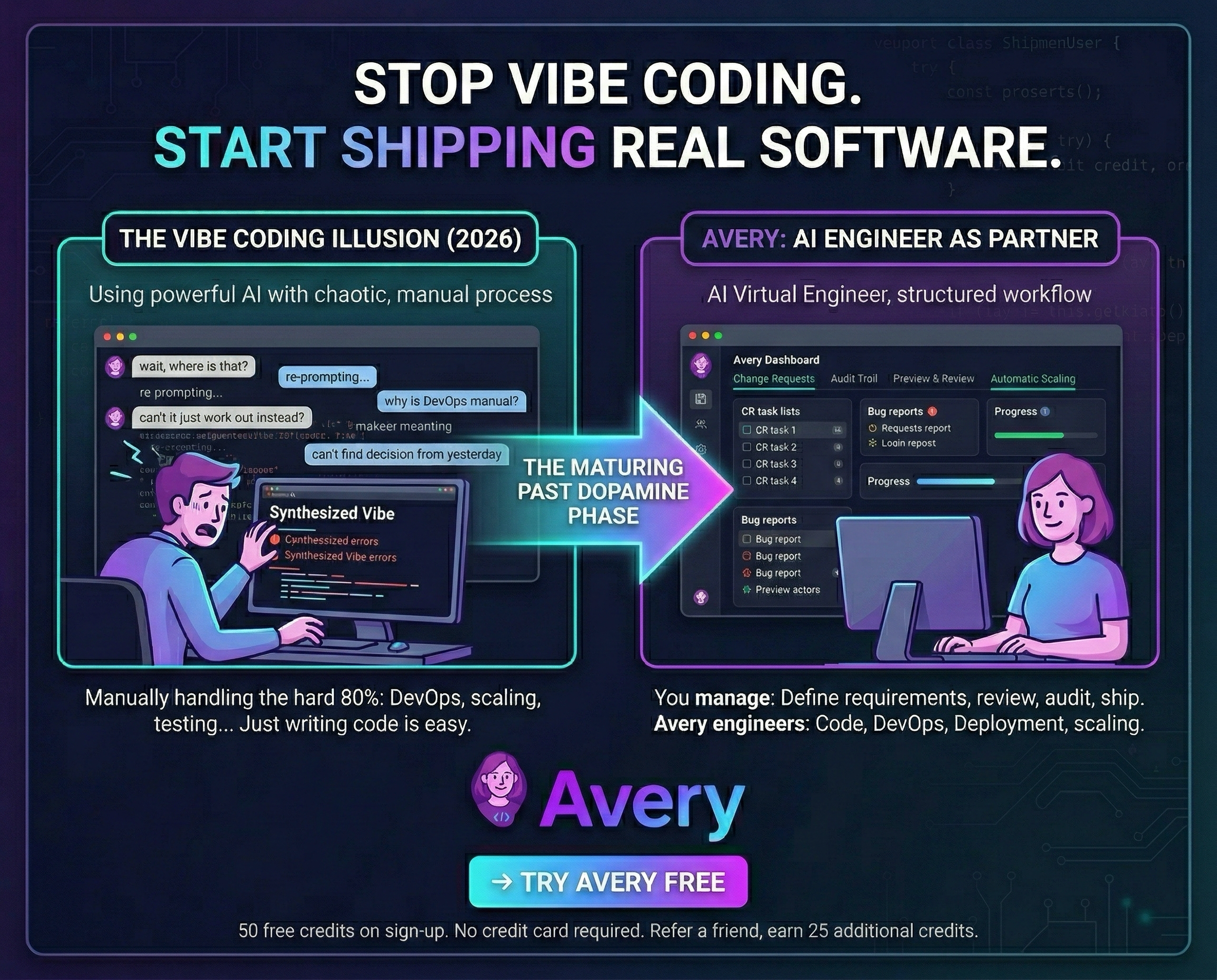
Vibe coding platforms let you chat your way to an app. Describe what you want, iterate through conversation, and out comes a prototype. The pitch is that you're no longer coding but that's not quite true. You're still spending the same time directing the build. You've just swapped a programming language for a natural language. The cognitive load shifted, but it didn't shrink.
AI-assisted IDEs and terminals take the opposite approach: AI lives inside your existing development environment as a code assistant. This is powerful for writing code faster, but it actually narrows what AI can do for you. You still own all the engineering and DevOps work that sits between writing code and running software in production: testing, deployment, infrastructure, scaling, monitoring. AI handles maybe 20% of the job. You handle the rest.
Both approaches share a deeper structural problem: they have no concept of process.
Why Chat-Driven Development Breaks Down
When your entire project history lives in a chat stream, you're building on a foundation that can't hold weight.
Every architectural decision is buried somewhere in a conversation thread. Every change request is an informal message that may or may not get acted on. Every "why did we do it this way?" requires digging through hundreds of messages to find the one exchange that matters.
Try auditing that. Try rolling back a specific change when something breaks in production. Try handing the project to someone new and telling them to reconstruct context from a chat log.
Chat is great for brainstorming. It's terrible for managing software. And the gap between those two activities is where real projects go to die.
What Production Software Actually Requires
Software teams at serious companies don't build through ad-hoc conversations. They follow a structured software development lifecycle because that structure is what makes software maintainable, auditable, and scalable. The essentials include:
Defined requirements before work begins , not vague descriptions that evolve mid-stream, but clear specifications that the engineering work is measured against.
Formal change requests that categorize work properly. Is this a new feature? A bug fix? An enhancement? A cosmetic change? The distinction matters for prioritization, testing, and release management.
Decision audit trails so that anyone, today or six months from now, can understand why something was built the way it was, without archaeologically excavating a chat history.
Task management with reopening so that when something is missed or a requirement changes, there's a structured way to revisit and revise, not a new message that may or may not get noticed.
Precise rollback to any prior state when a change introduces problems, without the panic of trying to reverse-engineer what the AI changed across your codebase.
Automated deployment and scaling so that shipping and handling traffic aren't manual, error-prone afterthoughts.
No current AI coding tool provides this. They give you a chat window and leave the engineering to you.
How Avery Works: You Manage, AI Engineers
Avery is built on a simple but powerful idea: AI should be your Virtual Engineer, and you should be the Manager.
This isn't a metaphor. It's the actual workflow.
A manager doesn't write code. A manager defines what needs to be built, creates tasks, reviews work, flags issues, audits decisions, and ships products. An engineer takes those inputs and does the technical heavy lifting: writing code, configuring infrastructure, handling deployments, fixing bugs.
Avery lets you operate as the manager across a complete engineering workflow:
Brainstorm through conversation. Start the way every good project starts, by talking through the idea. Discuss architecture, explore approaches, refine requirements. Chat is perfect for this phase, and Avery supports it fully.
Then move to structured action. Create formal Change Request tasks. Categorize them: new feature, bug fix, enhancement, cosmetic. Reopen them when something was missed. This is where Avery diverges from every other AI coding tool: the transition from discussion to tracked, auditable work.
Preview your application at every stage of development. Review what the AI engineer built. Report bugs the same way you would in any professional workflow, not by hoping the AI remembers a message you sent three hours ago.
Audit everything. Every action the AI agent took, every decision point, every change is traceable and reviewable. No digging through chat logs. No guessing what happened.
Roll back with precision. Something went wrong? Revert to an exact prior state. Not "undo the last few messages" but actual, reliable rollback.
Deploy and scale automatically. When you're ready to ship, Avery handles deployment. Traffic spikes? Scaling is automatic. No DevOps expertise required.
The result: you focus on the product, the requirements, and the decisions. Avery handles the engineering.
Pricing That Respects How You Work
We designed Avery's pricing around a principle: you shouldn't pay for AI when you're not using it.
50 free credits on sign-up. No credit card required. Enough to experience the full workflow and see how structured AI engineering actually feels.
Usage-based pricing after that. Buy credits when you need them. No monthly subscription draining your account while your project is on pause.
Referral rewards. Invite a friend and you both get 25 additional free credits.
Hosting starts at $29/month when you're ready to go live on our infrastructure, fully managed. Or export your code and host it anywhere you want. You own everything Avery builds.
The Shift That's Coming
The first wave of AI coding was about the thrill of instant prototypes. That phase served its purpose, it proved that AI can write functional code from natural language, and it got millions of people building who never would have otherwise.
But thrill doesn't ship products. Process does.
The next wave belongs to tools that treat AI not as a novelty but as a serious engineering partner, one that operates within the structure and discipline that production software demands.
That's what we're building at Avery.